
-
The Fighting Cock is a forum for fans of Tottenham Hotspur Football Club. Here you can discuss Spurs latest matches, our squad, tactics and any transfer news surrounding the club. Registration gives you access to all our forums (including 'Off Topic' discussion) and removes most of the adverts (you can remove them all via an account upgrade). You're here now, you might as well...
You are using an out of date browser. It may not display this or other websites correctly.
You should upgrade or use an alternative browser.
You should upgrade or use an alternative browser.
Tactics TFC's Tactical Autopsy Thread
- Thread starter bus-conductor
- Start date
Latest Spurs videos from Sky Sports

This is what no midfielders who looks like:
View: https://bsky.app/profile/windycoys.bsky.social/post/3m24mxbtnnc2e
View: https://bsky.app/profile/windycoys.bsky.social/post/3m24mxbtnnc2e

I don't agree with the last line (which is probably tongue in cheek anyway) but the rest is spot on and sums up our midfield clusterfuck right now. Signing Bentancur to a new contract is fucking nuts.
During our rebuilding teams series over the summer, I said that I thought Tottenham Hotspur’s biggest priority in the market needed to be a central midfielder who’s excellent at ball progression. They proceeded to sell none of their existing midfielders and buy no one who did that.
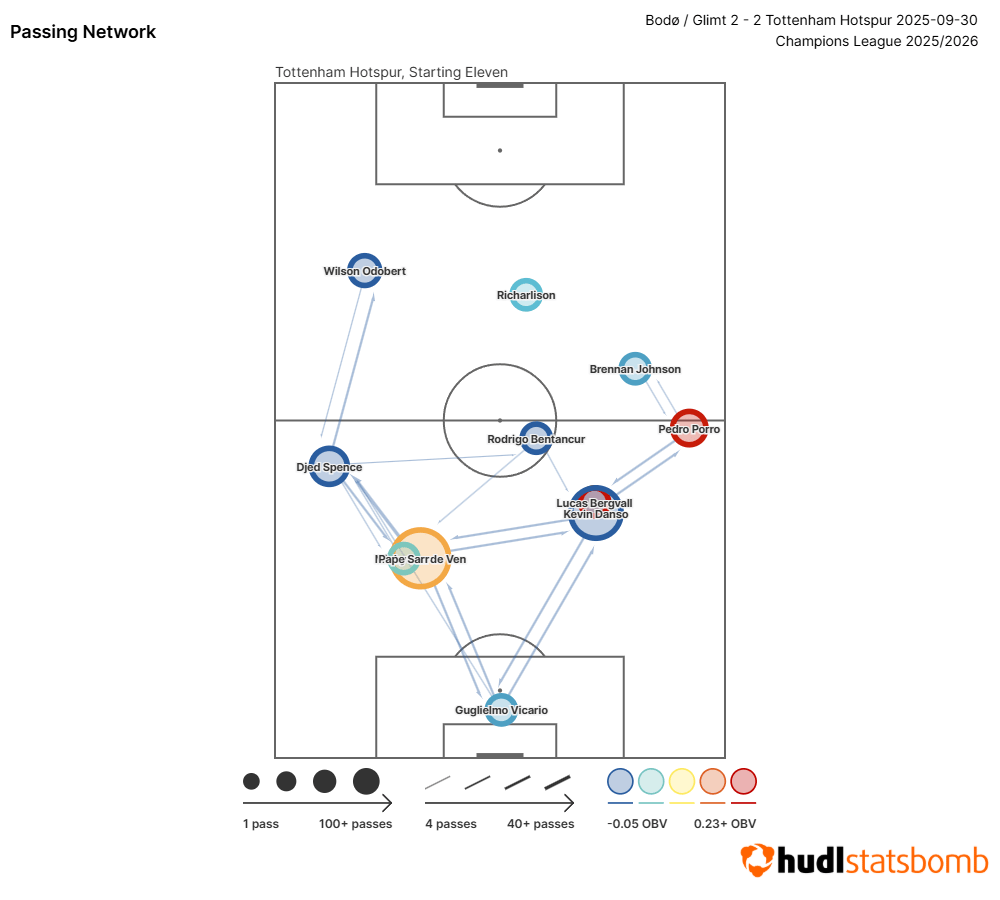
The results are apparent in this absolute war crime of a passing map from Spurs’ 2-2 draw with Bodo/Glimt midweek, which prompted me to make an admittedly grim and not very funny joke. Can you blame me, though? Look at this shit.
In miserably related news, Tottenham Hotspur announced a new contract for Rodrigo Bentancur on Friday morning. While Bentancur has a reputation as a great leader in the dressing room, and certainly looks the part of a top teammate on the pitch with his high work rate, he’s not a particularly good midfielder, which is ostensibly what he’s getting paid for.
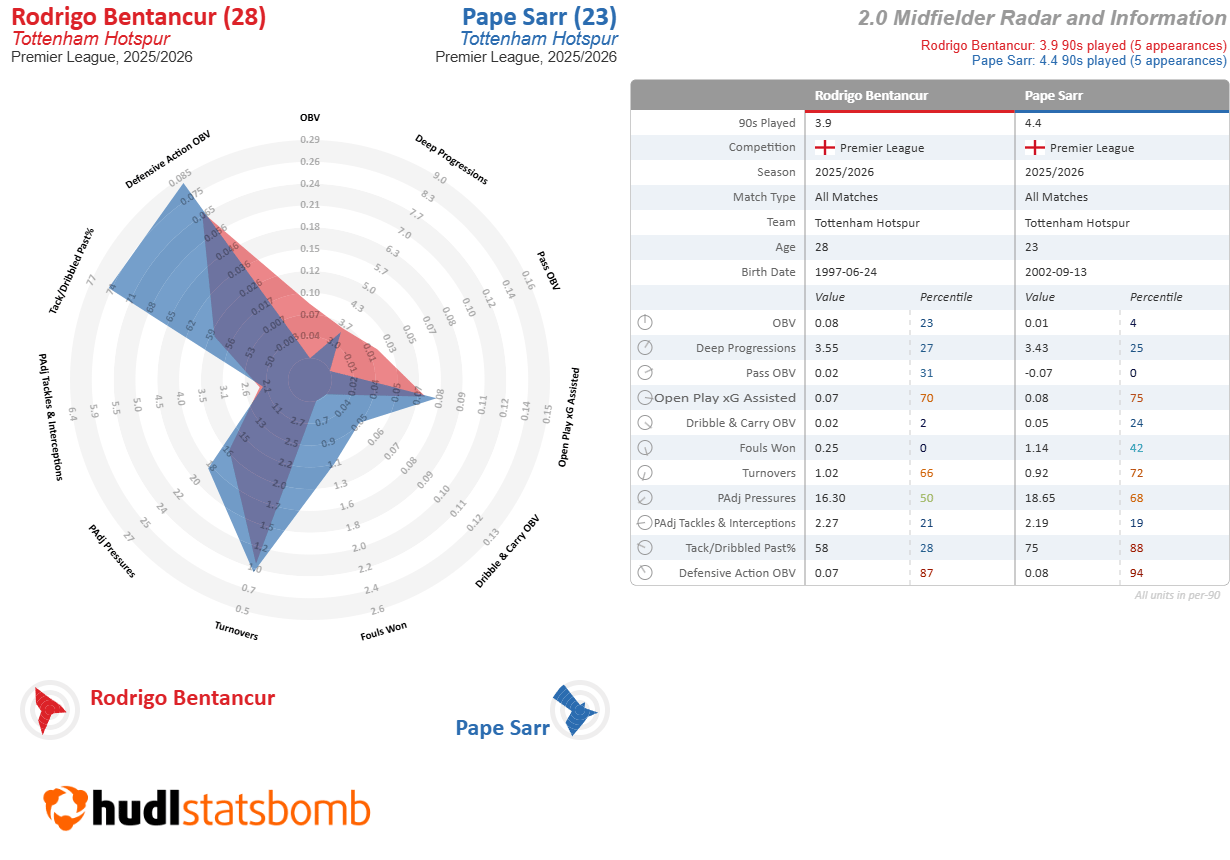
With Dejan Kulusevski and James Maddison out injured, likely future starting No. 8 Lucas Bergvall — who shows flashes of brilliance, even if he’s a bit frustrating on the whole — has been moved into a more attacking midfield role. The No. 8 minutes have mostly gone to the rotation of Bentancur and Pape Sarr, who is the exact same guy except younger and a bit more athletic.
Their passing and carrying numbers are revolting.
Some teams can carry a No. 8 who’s a true runner and destroyer if they either a) are just yeeting the ball to a striker partnership, or b) have a holding midfielder who is an elite distributor. But Spurs are currently playing 4-3-3/4-2-3-1 variants, and their No. 6 is Joao Palhinha, who might be the worst passer that a decent Premier League club is ever willing to start in midfield. He’s such an elite ball-winner that I’ll give him a pass — and he’s scored a couple of nice goals! — but his limitations become more obvious and punitive in Spurs’ side than they were in a more direct Fulham team, or a Bayern Munich side that had good passers next to him.
All of that is the main reason why, despite sitting 4th in the Premier League table, Tottenham’s attacking numbers look like this:
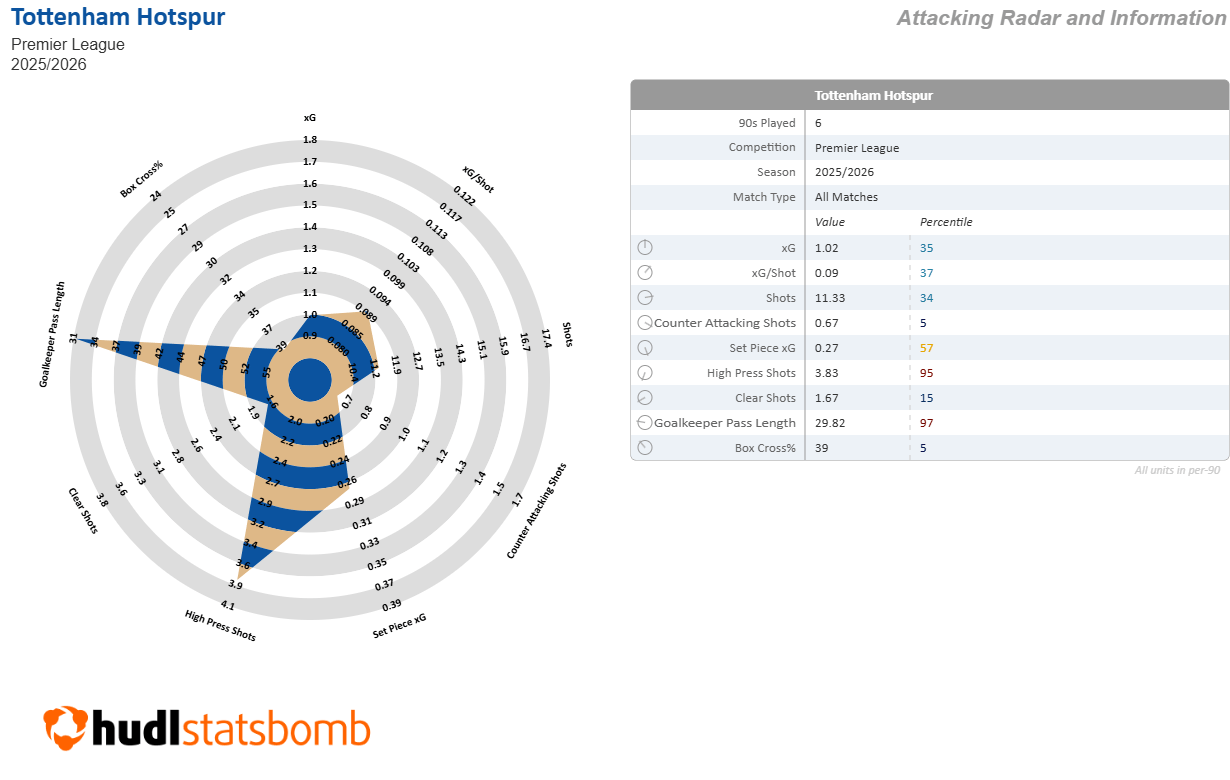
Xavi Simons has added some excellent playmaking ability to the Tottenham lineup, and the return of Kulusevski and Maddison in the 2nd half of the season should help quite a bit too, but none of them solve this team’s fundamental problem. It’s difficult for your elite advanced playmakers to create shooting opportunities if no one can get the ball through the middle third of the pitch and find them in the first place.
I don’t think Spurs have an internal solution to this problem. There will be calls to give Yves Bissouma another chance, to give Archie Gray more minutes, and to promote youngster Callum Olusesi to the first team. Perhaps one or more of them will perform better than the current crop of deep-lying midfielders currently getting minutes. But I am highly skeptical that any of them are THEanswer.
Long term, the answer is likely to sell Bissouma and Sarr, and buy a new midfielder. In the short term, I think Thomas Frank needs to seriously consider a tactical shift that involves playing 2 strikers and yeeting the ball in their general direction.
Tottenham should consider a midfielder who can pass
Hello and welcome to the Friday grab bag, which took a couple of weeks off for transfer grades. I’m happy to be back with some yelling about Tottenham’s midfield.During our rebuilding teams series over the summer, I said that I thought Tottenham Hotspur’s biggest priority in the market needed to be a central midfielder who’s excellent at ball progression. They proceeded to sell none of their existing midfielders and buy no one who did that.
The results are apparent in this absolute war crime of a passing map from Spurs’ 2-2 draw with Bodo/Glimt midweek, which prompted me to make an admittedly grim and not very funny joke. Can you blame me, though? Look at this shit.
In miserably related news, Tottenham Hotspur announced a new contract for Rodrigo Bentancur on Friday morning. While Bentancur has a reputation as a great leader in the dressing room, and certainly looks the part of a top teammate on the pitch with his high work rate, he’s not a particularly good midfielder, which is ostensibly what he’s getting paid for.
With Dejan Kulusevski and James Maddison out injured, likely future starting No. 8 Lucas Bergvall — who shows flashes of brilliance, even if he’s a bit frustrating on the whole — has been moved into a more attacking midfield role. The No. 8 minutes have mostly gone to the rotation of Bentancur and Pape Sarr, who is the exact same guy except younger and a bit more athletic.
Their passing and carrying numbers are revolting.
Some teams can carry a No. 8 who’s a true runner and destroyer if they either a) are just yeeting the ball to a striker partnership, or b) have a holding midfielder who is an elite distributor. But Spurs are currently playing 4-3-3/4-2-3-1 variants, and their No. 6 is Joao Palhinha, who might be the worst passer that a decent Premier League club is ever willing to start in midfield. He’s such an elite ball-winner that I’ll give him a pass — and he’s scored a couple of nice goals! — but his limitations become more obvious and punitive in Spurs’ side than they were in a more direct Fulham team, or a Bayern Munich side that had good passers next to him.
All of that is the main reason why, despite sitting 4th in the Premier League table, Tottenham’s attacking numbers look like this:
Xavi Simons has added some excellent playmaking ability to the Tottenham lineup, and the return of Kulusevski and Maddison in the 2nd half of the season should help quite a bit too, but none of them solve this team’s fundamental problem. It’s difficult for your elite advanced playmakers to create shooting opportunities if no one can get the ball through the middle third of the pitch and find them in the first place.
I don’t think Spurs have an internal solution to this problem. There will be calls to give Yves Bissouma another chance, to give Archie Gray more minutes, and to promote youngster Callum Olusesi to the first team. Perhaps one or more of them will perform better than the current crop of deep-lying midfielders currently getting minutes. But I am highly skeptical that any of them are THEanswer.
Long term, the answer is likely to sell Bissouma and Sarr, and buy a new midfielder. In the short term, I think Thomas Frank needs to seriously consider a tactical shift that involves playing 2 strikers and yeeting the ball in their general direction.

Tottenham’s back four are going long – and it’s working
With the lack of a progressive passer in central midfield, Romero and Porro have taken on additional tasks to move the ball up the pitch
 www.nytimes.com
Tottenham’s back four are going long – and it’s working


Ahmed Walid
Oct. 6, 2025Updated 7:20 am GMT+2
In the past two seasons, Tottenham Hotspur’s back four have mainly played short passes, with the full-backs occupying narrow positions inside the pitch. There has, however, been a change under their new head coach, Thomas Frank.
Since pre-season, Spurs’ defensive line — namely Cristian Romero and Pedro Porro — have been playing more long balls, either to find runners behind the opponent’s defence, isolate the wingers in one-versus-one situations, or kick-start the team’s quick build-ups.
Romero and Porro have taken on additional responsibility to move the ball up the field, especially when Tottenham’s midfield lacks a progressive passer.
Additionally, their long passes from defence have been a useful attacking solution, as seen in this example from the 1-1 draw against Newcastle United in pre-season, where Porro finds Son Heung-min’s run behind the defence. But the latter is flagged offside.

In another example, from the 3-0 victory against West Ham United in September, Romero has the ball as Lucas Bergvall is readying himself to attack the space between Konstantinos Mavropanos and Kyle Walker-Peters, who momentarily loses the Sweden midfielder when checking Xavi Simons’ position.

Romero then plays an inch-perfect long pass into space…

… and Bergvall heads the ball over the goalkeeper to score his first Premier League goal for Spurs.

Frank and his staff have been working with Bergvall to improve his game, and perfecting these runs is something they have been focusing on.
“He’s got so much energy that sometimes you need to say, pause, stop, don’t run when we have the ball, and find the higher, the more dangerous positions,” said Frank last month.
“For example, the deep run where he scored the goal against West Ham was a big thing. The deep run where he was involved in the own goal against Villarreal. So those deep runs and arriving in a higher position up the pitch are key.”
The deep runs need a passing source to complement them, and Romero and Porro have been inclined to go direct to find runners behind the opponent’s defence or between the lines.
In Tottenham’s first Premier League match this season, a 3-0 victory against Burnley, it was Romero’s line-splitting pass that started the move that led to Brennan Johnson’s goal.
Here, the Argentina centre-back plays the ball through Burnley’s block to find the dropping Richarlison. Meanwhile, Pape Matar Sarr curves his run to be able to combine with his centre-forward.

Richarlison’s movement drags Burnley’s left centre-back, Maxime Esteve, up the pitch, which forces the central centre-back, Hjalmar Ekdal, to drop and cover the space.
As Tottenham’s centre-forward is controlling the ball, Sarr seizes the opportunity and takes it from his team-mate…

… before finding Johnson’s run behind an disorganised back three: Esteve is dragged up the pitch by Richarlison, Kyle Walker has to defend Sarr, and Ekdal’s earlier movement is keeping Johnson onside.

Tottenham’s left-winger then carries the ball forward, before scoring to seal the victory.

Johnson’s opener in the 2-0 win against Manchester City followed the same attacking principles, but the combination came in the wide area and had a different pattern. In the build-up to that goal, it was Porro’s long pass that started the move.
Here, Tottenham start the attack through their right-back because Omar Marmoush’s pressing role allows him an extra second on the ball.

As Porro shapes himself to progress the ball, Mohammed Kudus drops to move Nathan Ake out of position and vacate the space for Sarr to attack.
The Senegal midfielder sprints forward as Tottenham’s right-back plays the ball towards the target area.

Attacking the pass from a more dynamic position (on the run) than Ruben Dias helps Sarr beat the centre-back to the ball and out-jump him to flick it into the path of Richarlison.

Tottenham’s centre-forward then plays the ball across the goal to find Johnson, who scores with a one-touch finish.


This season, Porro has varied his passes, playing longer to start a quick build-up or when the opportunity arises.
The ratio of his passes played long — defined as balls that travel at least 32 metres (35 yards) — has increased to 22 per cent in 2025-26, compared to 15 per cent the previous season and 10 per cent the one before.

Porro’s long passes have been a consistent weapon for Spurs this season. In the 2-1 victory against Leeds United on Saturday, it started the move that led to the winner.
Initially, Romero has the ball, with Porro and Kudus down the right side. Up front, Mathys Tel is pinning Leeds’ centre-backs. But the important movement comes from Simons, who drops deeper and drags Ethan Ampadu with him.

By moving Leeds’ deepest midfielder up the pitch, Tottenham put Kudus in a one-versus-one situation against Gabriel Gudmundsson. The next step is to play the ball into the right-winger before the opponents adjust their positioning.
Once Kudus is isolated against Leeds’ left-back, Romero passes the ball to Porro, who immediately plays it long into the space.

Tottenham are fortunate that the ball hits Gudmundsson and Kudus can quickly pick it up, but the approach is sound: isolating your physically and technically superior winger increases the probability of winning second balls or one-v-one duels.

Kudus then dribbles inside before striking the ball into the bottom corner.

Whether it’s to put wingers in one-versus-one situations, find late runners into the penalty area, or ignite the quick passing combinations that slice through opponents, Romero and Porro’s long passes have been integral to Tottenham’s attack under Frank.

How Thomas Frank’s Tottenham can improve in attack after strong start to season
There is still a sense that more potential can be unlocked from this Spurs side, particularly in terms of their potency going forward
www.nytimes.com
How Thomas Frank’s Tottenham can improve in attack after strong start to season
Summarise
Mark Carey
International breaks are always an ideal opportunity for managers and head coaches to pause for thought.
Thomas Frank has now notched up 10 competitive games in the Tottenham Hotspur dugout — it’s 11 if you include the UEFA Super Cup against Paris Saint-Germain to end their pre-season — and it has been a steady start for the club’s new head coach.
Spurs sit third in the Premier League with 14 points from seven matches. Four points in their opening two Champions League fixtures is also not to be underestimated, even if their 2-2 draw with Bodo/Glimt fell below expectations.
For Tottenham fans, there is still a sense that more potential can be unlocked from this side in the coming months, particularly in terms of their potency in open play going forward. It is worth having a frank discussion — or rather, a Frank discussion — on how Spurs can improve in attack.
The contrast from the dogmatic style of Ange Postecoglou over the previous two seasons is well-established by now.
Frank is a known pragmatist from his prior job at Brentford, intelligently adapting and tweaking the team’s setup depending on the strengths and weaknesses of the opposition, while still trying to impose his own ideas on the game.
That is abundantly clear when comparing Spurs’ first two competitive games under him, against Champions League holders PSG and promoted Burnley. In the former, a careful, risk-averse approach saw Frank set up in a 3-5-2 system to thwart the creative threat from Luis Enrique’s side and congest central areas, with Rodrigo Bentancur, Joao Palhinha and Pape Matar Sarr an excellent, combative midfield trio.
At home to Burnley a few days later, Frank’s side were far more considered in their possession, using goalkeeper Guglielmo Vicario as an auxiliary centre-back at times when building up, as Archie Gray, Lucas Bergvall and Sarr formed a more progressive midfield three.

Frank’s midfield has been a great source of debate in the early weeks of this season. Bentancur and Palhinha have been selected most often so far, but there is often a lack of variety or creativity when Tottenham are moving the ball through the thirds.
In certain matches, there is a desire for a solid defensive foundation in the middle, which requires the skill sets Bentancur and Palhinha bring to the table: the 2-0 win away to Manchester City on August 23 being a good example. However, on days where the onus is on Frank’s team to take the game to the opposition, there is a feeling those two aren’t both required. There have been instances where ball progression has been notably lacking from midfield in the opening weeks.
Sarr and Bergvall’s energy and late runs into the box are more preferable against weaker opposition to disrupt the back line. Meanwhile, new signing Xavi Simons is still settling into Premier League life, but has largely operated as a left-winger in his opening appearances. Playing Simons as a No 10 against Leeds in Spurs’ 2-1 away victory on Saturday did seem to add more balance to Frank’s side in possession; it was a midfield that had a solid defensive foundation while having enough creativity in the other direction.
Stay in the know by selecting your interests on The Athletic:
In mitigation, Tottenham have built a squad that does possess the players to link the midfield and attack, but with James Maddison and Dejan Kulusevski both out injured for the coming months, there is a need for more midfield players to be braver when progressing the ball.
Direct, long balls that bypass the midfield have been lucrative, but when looking across the opening 10 games in all competitions, there has been evidence of Spurs horse-shoeing possession from side-to-side too often, hoping that one of their wide players — namely Mohammed Kudus — will come up with some magic.

Frank’s side are not turning possession into chances at a rate they would like to. It is still early in the season, but 34 per cent of Spurs’ possessions so far have ended in a shot — which represents their lowest rate since 2018-19.
Attacking options have also been limited by injuries to strikers Dominic Solanke and Randal Kolo Muani. Richarlison is a willing worker at the top end of the field, but lacks the requisite dead-eye finishing to shoulder Spurs’ goalscoring burden. Mathys Tel will take confidence from his goal in Leeds but he too has plenty of room for improvement in his game before he can be considered an undroppable attacker.
There has been a reliance on Kudus to be the main creative threat in these opening weeks, with the Ghana international holding width on the right flank, willing to run in behind or receive to feet before cutting inside onto his stronger left foot. He is so often a release valve for opposition pressure with his unpredictability and fleet-footedness on the ball — shown by his 60 take-ons being more than any other Premier League player this season.
Kudus’ first Tottenham goal, which proved the winner against Leeds, was just reward for his efforts in recent weeks, but Spurs need more balance on their left-sided attack. As well as the searching crosses from Pedro Porro, there is a notable skew in the direction that their chances are coming from.

Frank has plenty of options on the left side of attack, including Simons, Kolo Muani, Brennan Johnson and Wilson Odobert, but none offer the same quality that Kudus offers from the right. Simons’ early games on the left saw the Netherlands international often drift inside to receive the ball to feet, which is hardly surprising given that his best qualities are operating between the lines and finding pockets to create for players ahead of him.
The return of left-back Destiny Udogie after missing the start of the season through injury has been crucial in providing more balance going forward, with his overlapping and underlapping runs offering more natural width than the deputising Djed Spence provided.
The early connection between Udogie and Simons has been promising, and it looks like there will be more understanding of each other’s games as the season progresses.
Against Wolves on September 27, Udogie makes an excellent overlapping run on the outside of Simons, but the latter opted against the pass and drove into a congested area before being dispossessed:

There was a very similar scenario a week later at Elland Road. And this time, Udogie’s run is found as Simons attracts bodies towards him before releasing the ball to his left-back in space (below).
Spurs do not have a left-sided player of the profile of Kudus, but the network of Simons, Udogie and Odobert proved to be a creative outlet on Saturday, as they consistently overloaded that side of the pitch.

It is the age-old difficulty for a club such as Spurs, whose stature in the game suggests they should be imposing themselves on the other team just about every week. An ability to adapt between matches is positive, but there should be more occasions where the opponents are more worried about the threat of Frank’s side than the other way around.
The new Tottenham coach has instilled a greater solidity and resilience in the side that looks to be an excellent foundation for long-term success, but those attacking tools will need sharpening in the short term.
With the anticipated absence of some key players until the new year, greater creativity might be required in more ways than one.

View: https://www.reddit.com/r/soccer/comments/1o30zxo/im_a_premier_league_setpiece_coach_ask_me_anything/
Apparently he's going to be answering the questions on 14th October at 4:30pm
''Hi, I'm Andreas Georgson, set-piece coach at Tottenham Hotspur, and I'll be sitting down to answer questions from Reddit users on Tuesday, October 14th, at 4:30 PM UK time.
I’ll try to explain what this role entails, how people in my position work with other members of the coaching team, and what life is like at Tottenham Hotspur, among other topics.
So, leave your questions below now, and I'll get through as many as I can on Tuesday afternoon.
COYS!''

View: https://x.com/dataanalyticepl/status/1979463740438306896?s=46&t=IomICbZIqZC4FsH907qgfw
View: https://x.com/dataanalyticepl/status/1979463997603668133?s=46&t=IomICbZIqZC4FsH907qgfw
View: https://x.com/dataanalyticepl/status/1979464147923349706?s=46&t=IomICbZIqZC4FsH907qgfw
View: https://x.com/dataanalyticepl/status/1979464303523537238?s=46&t=IomICbZIqZC4FsH907qgfw
Why are we on those last 2 charts twice?
Those tweets have disappeared, maybe that’s why?
This is very damning and underscores what I’ve been saying about how Frank hadn’t improved us defensively at all - so far…
View: https://x.com/dataanalyticepl/status/1979500270347248052?s=46&t=IomICbZIqZC4FsH907qgfw
View: https://x.com/dataanalyticepl/status/1979500270347248052?s=46&t=IomICbZIqZC4FsH907qgfw

This is very damning and underscores what I’ve been saying about how Frank hadn’t improved us defensively at all - so far…
View: https://x.com/dataanalyticepl/status/1979500270347248052?s=46&t=IomICbZIqZC4FsH907qgfw
Nonsense. We are much better defensively all over the pitch.